Subnet Splitter
Divide one IPv4 network into equal smaller subnets. Each child starts on its own boundary, and the children cover the parent exactly once.
How the cut is chosen
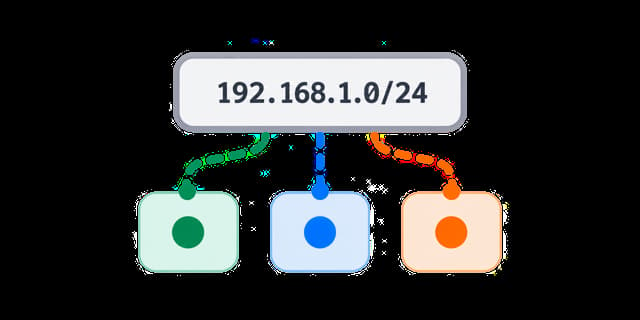
The parent is aligned to its own network address first. 192.168.1.50/24 is the block 192.168.1.0/24, then that block is walked in steps of the child size.
A new prefix of /26 has a block size of 64. The four children are 192.168.1.0/26, 192.168.1.64/26, 192.168.1.128/26, and 192.168.1.192/26.
Each row is a whole subnet, not a list of usable hosts. Inside each /26, 62 addresses are usable hosts. The network and the broadcast of that child stay in the block. The four children cover the parent once, with no gap and no overlap.
Questions
This splitter cuts a prefix into equal longer prefixes. A /24 split into /26 produces four blocks of 64 addresses. Different sizes belong in the VLSM calculator.
256 subnets. A /16 split into /24 is the widest cut shown. A wider cut still has a correct count, and you can choose a prefix closer to the parent.
No. Both are the block 192.168.1.0/24. The split starts at .0, then steps by the size of the new prefix.
Yes. Each extra bit doubles the count. /24 to /30 is six bits, so 64 subnets, and 64 is under the 256-row cap. Each /30 has 4 addresses and 2 usable hosts.
Sources
Reviewed 8 October 2026. The methodology page records what these labels do not cover.