Frequently Asked Questions
Short answers about subnets, CIDR notation, usable hosts, and the labels this site will and will not apply.
A subnet is a contiguous block of IP addresses that share the same network prefix. The prefix length says how many leading bits are the network. The remaining bits distinguish hosts inside that block.
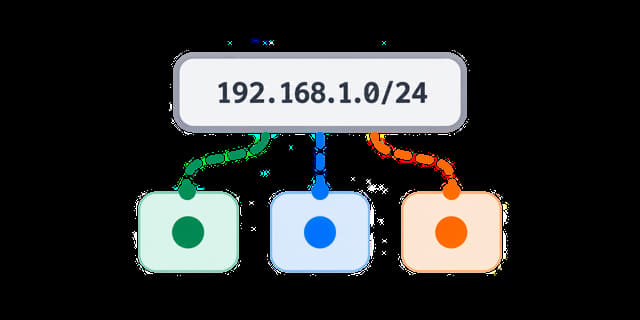
CIDR notation writes an address and a prefix length, as in 192.168.1.0/24. The /24 means the first 24 bits are the network. That prefix is the subnet mask 255.255.255.0.
For a conventional IPv4 prefix from /0 through /30, usable hosts are 2 to the power of the host bits, minus 2. The network address and the broadcast are the two addresses that are not hosts. A /24 has 8 host bits, so 256 total addresses and 254 usable hosts.
A /30 has 4 addresses and 2 usable hosts under the usual network-and-broadcast rule. A /31 also has 2 addresses, and RFC 3021 uses both of them as hosts on a point-to-point link. Subtracting 2 from a /31 would hide those hosts.
A /32 names a single address. Network, broadcast, and host are the same value. It is a valid prefix, not an error.
No. Classful addressing is historical. A /24 happens to be the old class C size, but the prefix is what sizes the block. This site shows the class only as a label.
No. Loopback, link-local, shared CGNAT space, documentation ranges, multicast, and reserved blocks are also special. An address outside RFC 1918 is not automatically safe to call public.
192.168.001.010 is rejected. Some stacks treat a leading zero as octal. Write 192.168.1.10.
A wildcard mask is the inverse of the subnet mask. In a Cisco-style ACL, a 0 bit must match and a 1 bit is ignored. The wildcard for 255.255.255.0 is 0.0.0.255.
No. IPv6 does not use a broadcast address, and this site does not subtract two hosts from an IPv6 prefix. Neighbor discovery uses multicast. The last address in the prefix is just the last address.